Kanji tattoos

Showing posts with label prison tattoos. Show all posts

Monday, April 13, 2015

Russian Criminal Tattoos: Russian Church tattoos

The church (sometimes depicted as a cathedral, monastery, fortress. etc, but usually depicted as a traditional russian church) is one of the main themes of "Vory v Zakone" tattoos. Usually this tattoos are large, covering significant areas of the chest or of the upper back. The number of domes/cupolas/towers signifies the number of convictions or, less often, it represent the number of years of incarceration (usually each dome represents a conviction; the number of the years served in prison is indicated trough dots tattooed on the knuckles).


(Photo: Arkady Bronnikov/FUEL Russian Criminal Tattoo Archive)

Thursday, March 26, 2015

Russian Criminal Tattoos: Madonna and Child

A thief in law (Russian: vor v zakone) in the Soviet Union, the post-Soviet states and respective diasporas abroad is a specifically granted formal status of a professional criminal who enjoys elite position within the organized crime environment and employs informal authority over its lower-status members. Each new Vor is vetted (literally "crowned", with respective rituals and tattoos) by consensus of several Vors. Vor culture is inseparable with prison organized crime: only repeatedly jailed convicts are eligible for a high Vor status. Thieves in law are drawn from many nationalities from a number of post-Soviet states. According to the estimates of the Russian Ministry of Internal Affairs, there were about 500 "thiefs-in-law", with the majority being of Caucasus ethnicities.(source: Wikipedia).

The Vor v Zakone are also known for their impressive tattoos. Tattoos are often done as a rite of passage in the criminal world - some of the Vor v Zakone members are tattooed before they are even sentenced to prison. It is hard to decode these tattoos because most of the tattoos have multiple hidden meanings. Some of the most common imagery is religious: the Madonna and Child, Russian churches, crosses, etc. However, these tattoos have absolutely nothing to do with religious beliefs; their real meanings are rooted in prison and criminal traditions.

For example, Madonna and baby Jesus is one of the most popular tattoos worn by criminals, and usually this tattoo symbolise loyalty to a criminal clan (the bearer of the tattoo is "clean before his friends" in that he will never betray them to authorities); it can also mean that the wearer believes the Mother of God will ward off evil; as well as meaning that the wearer has been behind bars from an early age.

(Photo: Arkady Bronnikov/FUEL Russian Criminal Tattoo Archive)

Saturday, March 23, 2013

Skulls and skeletons tattoos (3)

Besides those already mentioned, there are some other meanings of the skulls tattoos that have their roots in some ancient beliefs and practices.

Skulls as trophies - it was a common practice to keep the skulls of the killed enemies and to display them as trophies (eg.: to decorate with them the city walls and towers, to keep the skulls on the palisades as a warning sign, to display them on pikes at the Traitor's Gate, etc) or even to use them as wine-cups. Skulls-tattoos as trophies are a very common theme when it comes to the gang tattoos, prison tattoos, etc. For example, if we consider the russian criminal tattoos, a skull tattoo signifies murder (a significant one). When a tattoo design combines skulls with military insignia (especially with the epaulets tattooed on the shoulders), it usually designates a murderer.

russian criminal tattoo: epaulets and skulls
The epaulets are distinctive decorations for the inmates who are members of the "Vory V Zakone" (aprox "Thieves in law"). An inmate who has this kind of tattoo is a person with a high position in the prison hierarchy. The presence of the skull designates the wearer as a murderer. Read more about this topic on this blog: russiancriminaltattoo.blogspot.com

russian criminal tattoo: epaulets, skulls and a spider web
A russian criminal tattoo. The presence of the epaulets indicates that the wearer has a high rank in the prison hierarchy. The presence of the skull designates the wearer as a murderer. The spider is a symbol with multiple meanings; it may symbolize racism, doing time in prison, drug addicted, etc. Read more about this topic on this blog: russiancriminaltattoo.blogspot.com


In the Mexican tattoo-culture, skulls and skeletons are linked with the celebration of the Day of the Dead. The most common themes and representations are: the sugar-skull (brightly colored and highly decorated), the partying skeletons (because El Dia de los Muertos is not a time for sadness, but for joy and celebration) and the in-loving-memory-tattoos (these tattoos include attributes of the passed person in the skull's design: her favourite flowers, his / her weaopns, facial features, etc).

a mexican in-loving-memory-tattoo
In-loving-memory-tattoo. Some of the passed person's features are still present (the moustache and the hair)

Mexican tattoo: a fancy dressed skeleton playing a violin
Typical Mexican tattoo: a fancy dressed skeleton playing a violin

a very popular Mexican holiday: the Day of the Dead
For the Mexicans, El Dia de los Muertos is not a mournful day, but a day of family gatherings and holiday cheer.


Alchemy and Magic - the skull is an ancient symbol and it has several embodiments of the alchemical “union of opposites”, an ancient doctrine which accepts a syncretism of conflicting views, a harmony as opposed to a never-ending conflict between Good and Evil.

a skull decorated with alchemical symbols
The skull is a one of the alchemical symbols


Wisdom - sometimes, a skull tattoo is a symbol of the mature realization of a continuity of life into death, and the ability to accept death. This is very important because it is only when a person can live with the presence of death that he can fully learn to appreciate life.

medieval depiction of the skull as a symbol of wisdom
A medieval depiction of the skull as a symbol of wisdom.

Related posts:
Various elements which can occur in a Death tattoo: skulls and skeletons (1)
Skulls and skeletons tattoos (2)
Death tattoo - various elements which can occur in a Death tattoo
Death tattoos: the main depictions of the Grim Reaper
Death Tattoos / Grim Reaper Tattoos: themes and meanings
Death tattoo - various elements which can occur in a Death tattoo - animals

Friday, February 15, 2013

Skulls and skeletons tattoos (2)

Many people choose to get a skull tattoo because they want to show their affiliation to a group or to show their beliefs and their devotion to them.

The famous Jolly Roger (the black flag with a white skull and two human bones crossed under the skull) once used by pirates, was both an intimidating signal and a symbol of the total disregard for the authorities, as well as a symbol of the absolute freedom. This symbol (which is still preserving its original meaning) symbol was integrated into various systems of symbols belonging to different subculture or/and counterculture groups (like the outlaw motorcycle clubs whose members often get Jolly Roger tattoos to show their lawlessness). Sometimes, the anarchists use the "Jolly Roger" as a symbol of rebellion against the organized authority.
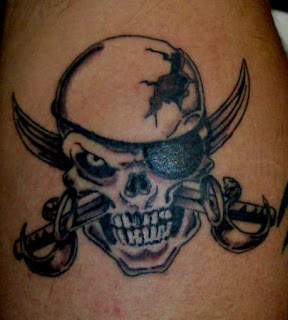


Jolly Roger tattoo: a pirate skull and two crossed pirate swords
a Jolly Roger tattoo


The Dead Man's Head consists usually of the human skull with or without the mandible and often includes two crossed long-bones (the femurs). Unlike the Jolly Roger design, the Dead Man's Head design features a skull with the crossbones placed behind the skull, instead of beneath it. The Dead Man's Head is an ancient symbol and has had different meanings over time; in the Elizabethan England, for instance, The Death's-Head Skull (usually a depiction without the lower jawbone), was emblematic of bawds, rakes, sexual adventurers and prostitutes; the term Deaths-Head was actually parlance for these rakes, and most of them wore half-skull rings to advertise their station, either professionally or otherwise. The original rings were wide silver objects, with a half-skull decoration not much wider than the rest of the band; this allowed it to be rotated around the finger to hide the skull in polite company, and to reposition it in the presence of likely conquests.
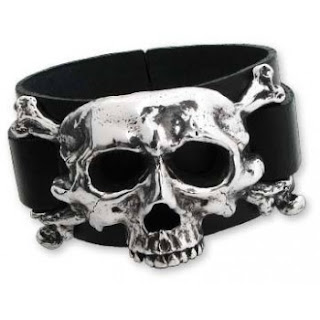
dead man's head ring
Dead Man's Head ring


The Totenkopf was used by the german Schutzstaffel (SS) as the unit's insignia. As a consequence of that, this particular design of the Dead Man's Head has become closely associated with various movements like the "white nationalist" movements, the "white power skinhead" movements and the "Neo-Nazi" movement.

a Totenkopf tattoo - a symbol of the Neo-Nazi movement
a Totenkopf tattoo - a tattoo design closely associated with the Neo-Nazi's ideology

the 3rd SS Division's Totenkopf flag
the 3rd SS Division's Totenkopf insignia
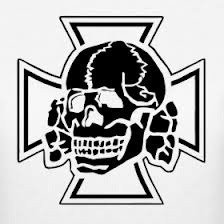
Totenkopf and Tatzenkreuz design
Totenkopf design; the draw also contain a variant of so-called "Cross Pattee (English: Cross Patty; German: Tatzenkreuz)"; the Cross Pattee is often mistakenly identified with the gothic crosses, but actually it is an ancient symbol which was largely used by the Teutonic Knights and sometimes by the Templiers. The Cross Pattee design was incorporated in the design of the "Iron Cross", a german decoration for military valor established by the King Frederick William III of Prussia in 1813. The Iron Cross remained in use, in various forms, by Prussia and later Germany until 1945.


Variations on the Skull and Crossbones are used by various military units as a symbol of strength, courage and bravure, as well as a symbol of the disregard for one's life. On wikipedia you can find a list of the Skull and crossbones military insignias.

the BOPE emblem
The BOPE emblem, a skull impaled on a sword, backed by two gold pistols sends out a strong, unambiguous message. The emblem symbolises armed combat, war and death. The BOPE’s emblem, a skull with a crisscross of pistols, is believed to possess mystical powers of protection. BOPE = Special Policial Operations Battalion, a special forces unit of the Military Police of Rio de Janeiro State, Brazil. If you want to know more about BOPE you can visit their blog or you can watch these two movies: Elite Squad and Elite Squad: The Enemy Within

Related posts:
Various elements which can occur in a Death tattoo: skulls and skeletons (1)
Death tattoo - various elements which can occur in a Death tattoo
Death tattoos: the main depictions of the Grim Reaper
Death Tattoos / Grim Reaper Tattoos: themes and meanings
Death tattoo - various elements which can occur in a Death tattoo - animals

Wednesday, April 4, 2012

The mark of Cain: the russian criminal tattoos (VII)


In the recent years, even in the russian prisons the criminal tattoos are slowly becoming unfashionable and many of the ex-convicts are trying to get rid of the tattoos (usually, the methods used to remove the tattoos are causing damages to the skin and permanent scarring).


Monday, April 2, 2012

The mark of Cain: the russian criminal tattoos (VI)

The criminal tattoos are becoming less and less popular in the russian prisons. Most of the new inmates don't know anything about the meanings of the old criminal tattoos and they are getting all kind of tattoos.

According to the old inmates, in the past times, the inmates used to have to answer for their tattoos and harsh punishments were meted out to inmates who couldn't give the right answer. The usual punishments included severe beatings, the breaking of the arms of the offenders and the cutting off of the tattoo along with the skin.


Saturday, March 24, 2012

The mark of Cain: the russian criminal tattoos (V)

The mark of Cain: the russian criminal tattoo (V)

Getting a tattoo in prison can be very risky for the health; AIDS, tuberculosis, hepatitis and syphilis are just a few examples of diseases that can be transmitted through tattooing.
There are over 100.000 convicts with TB in the russian prisons, and aprox 20.000 of them have an incurable form of tuberculosis.


Saturday, March 10, 2012

The mark of Cain: the russian criminal tattoos (IV)

The mark of Cain: the russian criminal tattoo, episode 3. The first episode can be seen here and the second episode can be seen here. The 3rd episode can be seen here

In this episode: details about the White Swan, the toughest prison in Russia


A tough convicted has the right to get a tattoo on the eyelids - usually a message like "Don't dare to wake me up!" - an avertisment for the other convicted to keep quiet when the tough guy is sleeping.

Tuesday, January 10, 2012

The mark of Cain: the russian criminal tattoos (III)

The mark of Cain: the russian criminal tattoo, episode 3. The first episode can be seen here and the second episode can be seen here.


Extras from this episode: The lowest category in the criminal world are the so-called Downcast. The men in the colony who fulfill, mostly by force, the female role. [...] These people (the Downcast) live separately, they eat separately,they sit apart in the mess hall. They don't have the right to look in the eyes of the other convicts. [...] Sometimes they have humiliating words (like slave, or bitch) tattooed on their faces, so they can be easily recognized when they arrive in a new prison.

Monday, January 9, 2012

The mark of Cain: the russian criminal tattoos (II)

The mark of Cain: the russian criminal tattoo, episode 2. The first episode can be seen here.


Did you know...?

- the cross is one of the most popular tattoo designs among the russian convicts. If an inmate has a tattoo with the representation of the crucifixion of Christ, it means that he (the inmate) is the leader of a criminal organization