Kanji tattoos

Showing posts with label skeleton tattoos. Show all posts

Sunday, June 9, 2013

Skulls and skeletons tattoos (4)

Click on the links below if you want to read the previous posts:
Various elements which can occur in a Death tattoo: skulls and skeletons (1)
Skulls and skeletons tattoos (2)
Skulls and skeletons tattoos (3)


As it can be seen from the previous posts, a skull / skeleton tattoo could have various meanings:

Friday, February 15, 2013

Skulls and skeletons tattoos (2)

Many people choose to get a skull tattoo because they want to show their affiliation to a group or to show their beliefs and their devotion to them.

The famous Jolly Roger (the black flag with a white skull and two human bones crossed under the skull) once used by pirates, was both an intimidating signal and a symbol of the total disregard for the authorities, as well as a symbol of the absolute freedom. This symbol (which is still preserving its original meaning) symbol was integrated into various systems of symbols belonging to different subculture or/and counterculture groups (like the outlaw motorcycle clubs whose members often get Jolly Roger tattoos to show their lawlessness). Sometimes, the anarchists use the "Jolly Roger" as a symbol of rebellion against the organized authority.
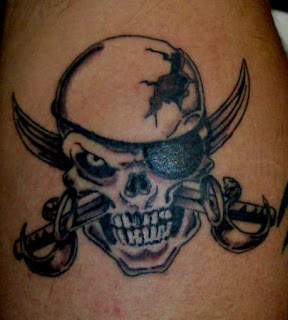


Jolly Roger tattoo: a pirate skull and two crossed pirate swords
a Jolly Roger tattoo


The Dead Man's Head consists usually of the human skull with or without the mandible and often includes two crossed long-bones (the femurs). Unlike the Jolly Roger design, the Dead Man's Head design features a skull with the crossbones placed behind the skull, instead of beneath it. The Dead Man's Head is an ancient symbol and has had different meanings over time; in the Elizabethan England, for instance, The Death's-Head Skull (usually a depiction without the lower jawbone), was emblematic of bawds, rakes, sexual adventurers and prostitutes; the term Deaths-Head was actually parlance for these rakes, and most of them wore half-skull rings to advertise their station, either professionally or otherwise. The original rings were wide silver objects, with a half-skull decoration not much wider than the rest of the band; this allowed it to be rotated around the finger to hide the skull in polite company, and to reposition it in the presence of likely conquests.
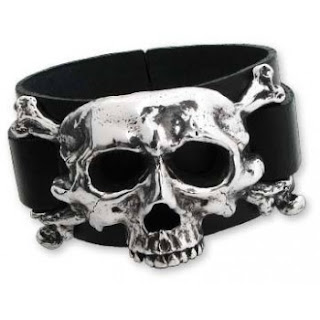
dead man's head ring
Dead Man's Head ring


The Totenkopf was used by the german Schutzstaffel (SS) as the unit's insignia. As a consequence of that, this particular design of the Dead Man's Head has become closely associated with various movements like the "white nationalist" movements, the "white power skinhead" movements and the "Neo-Nazi" movement.

a Totenkopf tattoo - a symbol of the Neo-Nazi movement
a Totenkopf tattoo - a tattoo design closely associated with the Neo-Nazi's ideology

the 3rd SS Division's Totenkopf flag
the 3rd SS Division's Totenkopf insignia
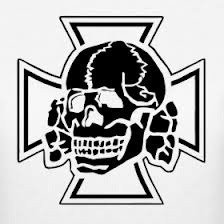
Totenkopf and Tatzenkreuz design
Totenkopf design; the draw also contain a variant of so-called "Cross Pattee (English: Cross Patty; German: Tatzenkreuz)"; the Cross Pattee is often mistakenly identified with the gothic crosses, but actually it is an ancient symbol which was largely used by the Teutonic Knights and sometimes by the Templiers. The Cross Pattee design was incorporated in the design of the "Iron Cross", a german decoration for military valor established by the King Frederick William III of Prussia in 1813. The Iron Cross remained in use, in various forms, by Prussia and later Germany until 1945.


Variations on the Skull and Crossbones are used by various military units as a symbol of strength, courage and bravure, as well as a symbol of the disregard for one's life. On wikipedia you can find a list of the Skull and crossbones military insignias.

the BOPE emblem
The BOPE emblem, a skull impaled on a sword, backed by two gold pistols sends out a strong, unambiguous message. The emblem symbolises armed combat, war and death. The BOPE’s emblem, a skull with a crisscross of pistols, is believed to possess mystical powers of protection. BOPE = Special Policial Operations Battalion, a special forces unit of the Military Police of Rio de Janeiro State, Brazil. If you want to know more about BOPE you can visit their blog or you can watch these two movies: Elite Squad and Elite Squad: The Enemy Within

Related posts:
Various elements which can occur in a Death tattoo: skulls and skeletons (1)
Death tattoo - various elements which can occur in a Death tattoo
Death tattoos: the main depictions of the Grim Reaper
Death Tattoos / Grim Reaper Tattoos: themes and meanings
Death tattoo - various elements which can occur in a Death tattoo - animals

Thursday, August 30, 2012

Death tattoos: the main depictions of the Grim Reaper

There are a variety of different ways that the Grim Reaper can be portrayed as a tattoo symbol. Most Grim Reaper tattoo designs portray the Reaper in a long black robe with his famous long scythe. The Grim Reaper can be shown holding his scythe in a variety of different positions, such as the front or over his shoulder. Due to the length of the robe, only certain parts of the Reaper are usually shown. Skeleton hands are usually seen holding the long scythe. Mostly, the legs are not visible and the Grim Reaper is depicted floating at some distance above the ground (occasionally surrounded by some green or blue mist). The face of the Grim Reaper is usually portrayed as a skeleton skull, with an evil grin and burning eyes. However, some Grim Reaper tattoos show the Grim Reaper as "faceless".

grim reaper / skeleton tattoo on the arm
Grim reaper tattoo - the most common representation of the Grim Reaper: a skeleton wearing a flowing black cloak and carrying a scythe; the skeleton has an evil grin on his face


faceless grim reaper tattoo / angel tattoo
faceless Death


floating Grim Reaper carrying a young girl
floating Grim Reaper; the legs are not visible


Sometimes, the Grim Reaper is depicted riding his legendary pale (or sometimes black) horse. This reference is from the Four Horsemen of the Apocalypse as mentioned in the Christian Bible. Each horseman is named after the power he represents. The fourth horseman - the Death - is described as riding a pale horse. Sometimes the Greek word “chloros” translates the horse’s color as “green” or “pale green” which could be a reference to the green skin color of the deathly ill or recently deceased. It is actually the third horseman that rides a black horse; however many grim reaper tattoos feature the Reaper riding this horse possibly due to the traditional interpretation of the color black representing famine, decay and death.

Death / Grim Reaper riding his black horse
Grim Reaper riding his legendary Black Horse


the Four Horsemen of the Apocalypse
the Four Horsemen of the Apocalypse - Death is riding the pale-green horse


In some tattoos, the Death / Grim Reaper is depicted seated on a throne of skulls or on a throne decorated with human skulls. Sometimes, the Death's throne is in the top of a huge pile of human bones and skulls.

the Death's throne, decorated with human skulls
The Death's throne, decorated with human skulls


Other depictions (e.g.: Grim Reaper sitting on the bed of a dying man, sitting on branch of a dead tree, sitting on a cross, etc), although present in some tattoos, are not so popular as the above mentioned depictions: the floating Grim Reaper, Grim Reaper riding his horse, Grim Reaper on his throne.

faceless Death waiting for a new victim
Death looking for a victim


mother Grim Reaper and a Grim Reaper child
unusual depiction of the Grim reaper with a baby Grim Reaper


Related posts:
Death Tattoos / Grim Reaper Tattoos: themes and meanings
Death tattoos: angels of death - themes and representations (1)
Death tattoos: angels of death - themes and representations (2)
Death tattoos: angels of death (1)
Angel of Death tattoos: examples and ideas

Saturday, August 25, 2012

Death Tattoos / Grim Reaper Tattoos: themes and meanings

Grim Reaper (also referred to as the Angel of Death) is a figure commonly used to represent death. The Grim Reaper became prominent in folklore during the Middle Ages, displacing earlier conceptions of Death as a benevolent, female figure. In 1479 in Cardiff, Duroc, seemingly a representation of Death who resembled a walking skeleton, appeared.

The Grim Reaper is often depicted as a skeleton or as a solemn-looking man wearing a flowing black cloak and carrying a scythe, who cuts off people's lives as though he were harvesting grain. Legend has it that he appears when one is nearing death to separate the human soul from the physical body using his sharp scythe. The Grim Reaper then chaperones the soul to its final destination (Heaven or Hell) and moves on to his next “appointment.” Although the Reaper is not a ghost, his is invisible and present at the moment of death.

Grim Reaper tattoos meanings:

The Grim Reaper and the Skull were often used as symbols in medieval and renaissance art as a stark reminder of the fact that life is finite and hints powerfully at the afterlife that awaits us. Various aphorisms and reflections (like "Memento mori", which can be translated as "Remember your mortality", "Remember you must die" or "Remember you will die") can be included in the design of these tattoos.

Carpe Diem (Seize the day)- the Grim Reaper tattoo can be a symbolic reminder that we are all mortal and to live life to the fullest and to accept your fate with bravery.

Death tattoos are very common among solders. As it represents courage, bravery, and not being afraid of death. You accept life for as it is, and strongly follow your goals.

Someone who has survived a grievous accident or life-threatening illness might get a Grim Reaper tattoo as a symbol of their triumph over death, or to remind themselves that just because they escaped once does not mean their future is certain.

The idea that "Life's a laugh and death's a joke" - usually, these tattoos contain comical or cartoon-like elements.


Below are several pictures with Grim Reaper tatoos:
Grim Reaper tattoo covering the shoulder and the upper arm


Black and white Grim Reaper tattoo


skull tattoo / memento mori tattoo
Death tattoo combining various elements: a skull, a clock - symbol of the of the relentless flow of time, a rose - a symbol of the ephemeral and the Latin phrase "Memento mori"


Related posts:
Death tattoos: the main depictions of the Grim Reaper
Death tattoos: angels of death - themes and representations (1)
Death tattoos: angels of death - themes and representations (2)
Death tattoos: angels of death (1)
Angel of Death tattoos: examples and ideas